
Want more ideas and freebies?
Try a free sample of my digital & print resources—plus tips over email.
Join to Try Free Resources →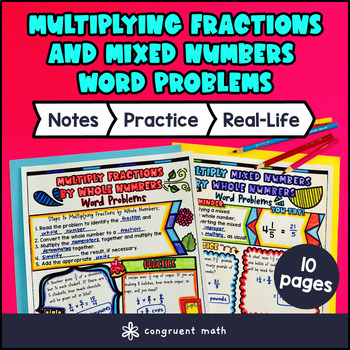
$4.25
Ever wondered how to teach multiplying fractions and mixed numbers in an engaging way to your 4th grade students?
In this lesson plan, students will learn about multiplying fractions by whole numbers and their real-life applications. Through artistic, interactive guided notes, checks for understanding, a color-by-code activity, and a maze worksheet, students will gain a comprehensive understanding of word problems involving this skill.
The lesson culminates with a real-life example that explores how multiplying fractions by whole numbers is useful in everyday situations.
After this lesson, students will be able to:
Before this lesson, students should be familiar with:
$4.25
As a hook, ask students if they have ever needed to share something like a pizza, a chocolate bar, or a carton of juice evenly among their friends. How would they figure out how much each person gets if they only had a part of a whole? Refer to the real-life math application page at the end of the guided notes as well as the FAQs below for additional ideas and examples.
Use the first page of the guided notes to introduce multiplying a fraction by a whole number. Walk through the key points: what it means to multiply a fraction by a whole number, how to interpret the word problems, and the step-by-step process for solving them (e.g., multiply the numerator by the whole number while keeping the denominator the same, then simplify if necessary). Refer to the FAQ below for a detailed walk-through, including common misunderstandings and questions about fraction multiplication.
Use the second page of the guided notes to introduce multiplying mixed numbers by whole numbers. Guide students through converting mixed numbers to improper fractions, multiplying by the whole number, and then converting back to mixed numbers if needed. Emphasize strategies for interpreting and solving word problems involving mixed numbers and discuss how to check answers for reasonableness. Refer to the FAQ below for ideas on how to handle common student questions and errors.
Based on student responses during the checks for understanding, reteach any concepts where students struggle, such as converting between mixed numbers and improper fractions or simplifying answers. For classes with varying proficiency, consider pulling small groups for targeted reteaching while more advanced students begin the practice exercises included later in the resource.
Have students practice multiplying fractions and mixed numbers by whole numbers using the color by code and maze activities. Walk around to answer student questions.
Fast finishers can dive into the problem sets activity for extra practice. You can assign it as homework for the remainder of the class.
Bring the class back together, and introduce the concept of using multiplication of fractions by whole numbers in real-life situations such as cooking or baking, where recipes often need to be adjusted for more servings. Discuss how understanding this math skill helps in measuring ingredients correctly. Refer to the FAQ for more ideas on how to teach it!
If you’re looking for digital practice for multiplying fractions by whole numbers word problems, try my Pixel Art activities in Google Sheets. Every answer is automatically checked, and correct answers unlock parts of a mystery picture. It’s incredibly fun, and a powerful tool for differentiation.
Here’s 1 activity to explore:
Try a free sample of my digital & print resources—plus tips over email.
Join to Try Free Resources →