
Want more ideas and freebies?
Try a free sample of my digital & print resources—plus tips over email.
Join to Try Free Resources → by Ping · September 13, 2023
In my 6th grade math classroom, we're all about practicing math concepts with a creative and practical twist.
In this blog post, I'm going to give you the lowdown on 5 awesome activities for teaching integers, opposites, and absolute values.
First, why do I love teaching integers, opposites, and absolute values?
Because it’s easy to connect it to real life. Positive and negative integers are perfect for describing all kinds of situations, from elevations (are you above or below sea level?) to money (did you make a profit or loss?), and even to temperatures (are you above or below freezing?).
And it’s a very visual topic. You can plot positive and negative integers on number lines as you practice comparing and ordering. When solving for absolute value, you can visually represent the distance away from zero on a number line.
Now, onto the good stuff. Here are 5 fun ways to teach integers, opposites, and absolute values.
Try a free sample of my digital & print resources—plus tips over email.
Join to Try Free Resources →What is it?
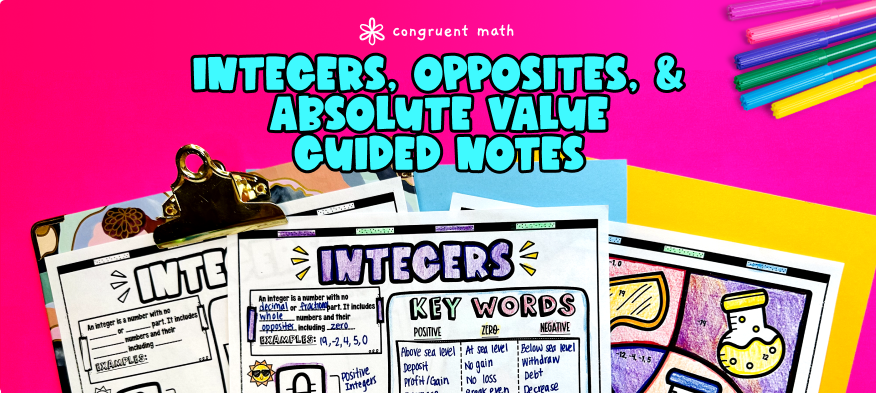
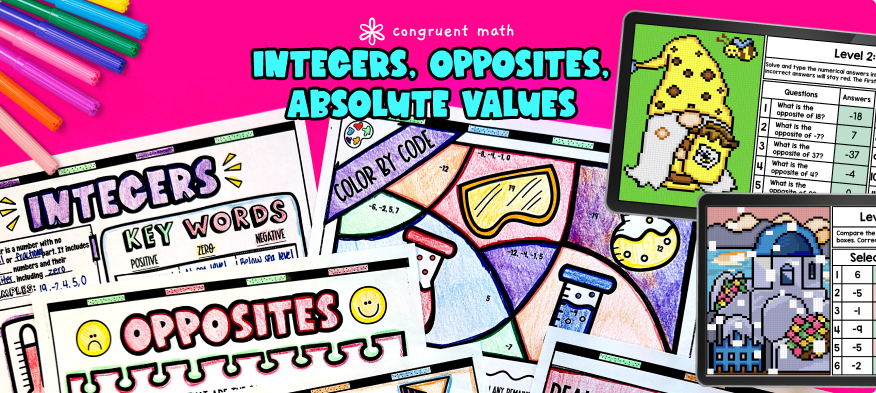
No-prep guided notes covering plotting integers on a number line, identifying opposites, and finding absolute value of rational numbers — with mazes and color-by-number sections built in for practice. Covers 6.NS.C.5, 6.NS.C.6, 6.NS.C.6.a, 6.NS.C.6.c, 6.NS.C.7, 6.NS.C.7.a.
First time teaching this unit? There's a matching formal lesson plan.
Why do I love this?
Doodling and coloring keep note-taking from feeling like a lecture, and the maze/color-by-number sections mean the practice is already built in — no separate worksheet to hunt down.
What is it?
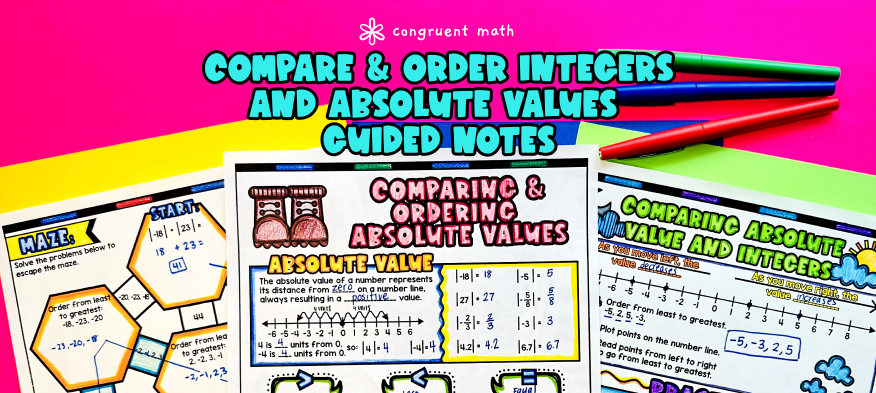
The follow-on set for comparing and ordering integers and rational numbers — built after realizing students need a visual, number-line way to compare values, not just compute them. Covers 6.NS.C.7 through 6.NS.C.7.d.
Why do I love this?
It's the natural next step after item 1 — same visual, doodle-friendly format, but aimed at the comparison skill students usually get shakiest on.
What is it?
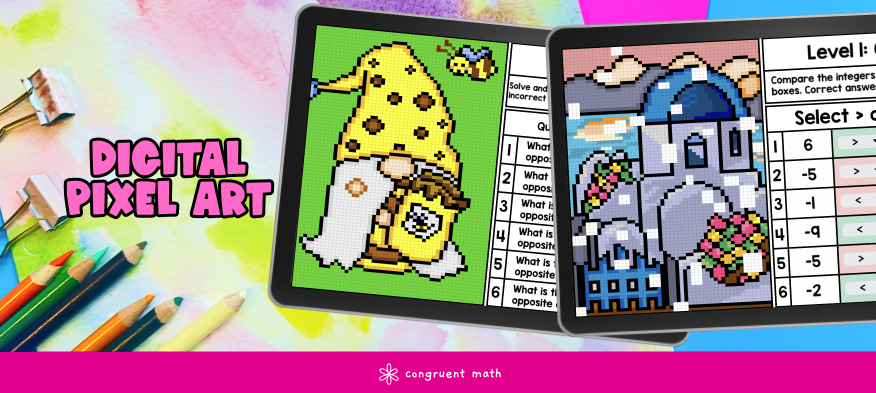
Self-checking digital pixel art in Google Sheets — this set on integers, opposites, and absolute value, plus a comparing-and-ordering version if you want the same format for item 2's skill.
Why do I love this?
Self-checking means I can circulate and help struggling students instead of grading; each correct answer unlocking more of the mystery image is what keeps kids motivated to finish.
What is it?
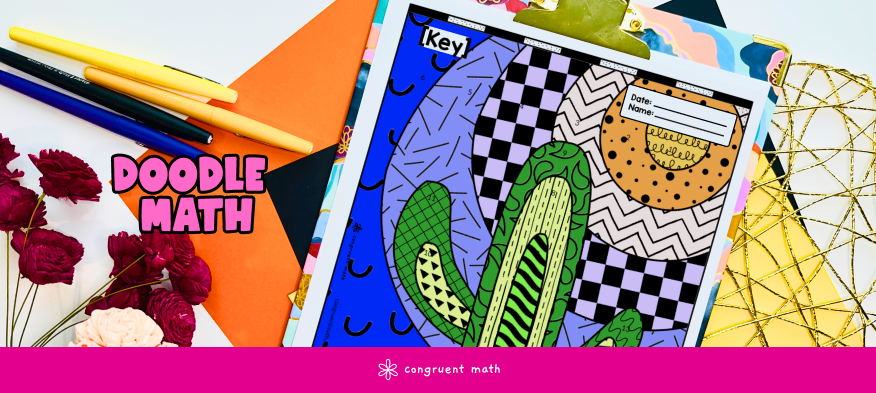
A twist on color-by-number — students unlock doodle patterns as they solve integer, opposite, and absolute-value problems, then color the finished image however they like.
Why do I love this?
Doodling + Math = Pure FUN! Just listen to what one teacher had to say about Doodle Math:
⭐⭐⭐⭐⭐ “This was difficult for my accelerated students! I loved it and so did they! They found trying to doodle the drawing and win ‘the best doodler’ fun. Students were engaged with the math, but also with their creativity.” - Kay Y.
What is it?
Free-play review games: Kahoot for definitions and drilling absolute value, Blooket for comparing integers, Quizizz for real-life applications of integers.
Why do I love this?
Built-in competitive energy gets even the reluctant reviewers to actually practice, and I can run any of the three depending on which platform the class responds to that day.
There you have it — 5 ways to teach and practice integers, opposites, and absolute value that your students will actually enjoy.
P.S. For the best deal, grab the top 4 activities together. Click here.
I spent 7 years in the classroom working to make math fun and relevant in middle school, by integrating math, art, and technology. I started Congruent Math to share this all with you.
Try a free sample of my digital & print resources—plus tips over email.
Join to Try Free Resources →